# :icon-crosshairs: Moving Objects
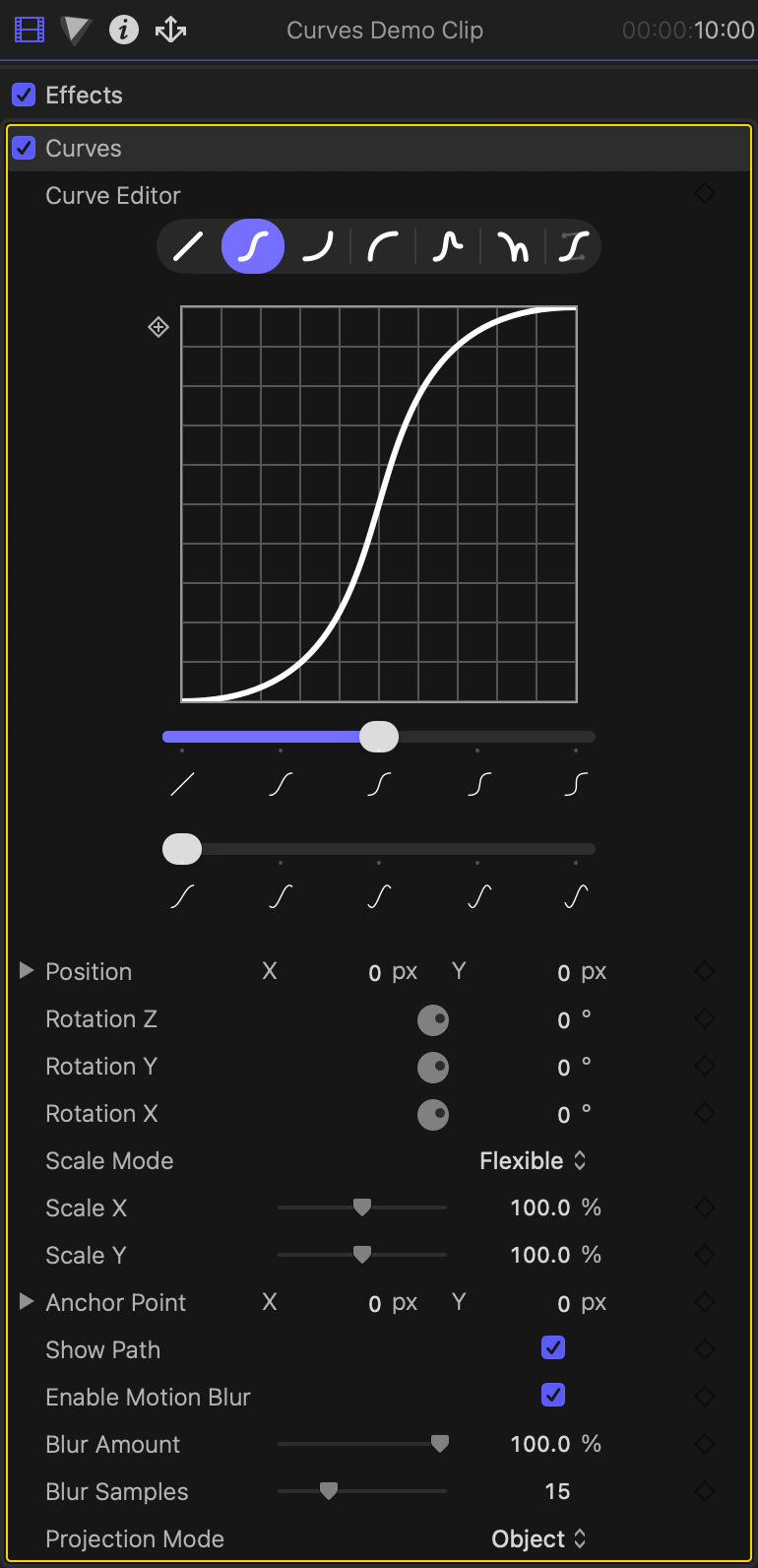
Once *Curves* is applied to a clip, use the on-screen controls and inspector
settings to adjust its position, rotation, and scale. The on-screen controls
only appear if the Curves effect is selected, so make sure to select the Curves
effect in the effects tab of the inspector (). A yellow box will appear
around it.
A control () will appear
in the viewer over the center of your clip. Click and drag it to move your
object around:
Curves tries its best to help you keep everything aligned in your scene by
snapping your object to the center or lower/ upper thirds. When you add
animations, Curves will snap to align with other keyframes as well. This helps
keep your animations centered, fluid, and consistent.
However, it may be desirable to disable snapping in certain scenarios. Start
dragging the object then hold down one of the following keys to configure the
dragging behavior:
{.compact}
Key |Effect
--- |---
*None* | Snap to the center, lower/upper thirds, and other keyframes.
Option (⌥) | Move the anchor point instead of the object itself.
Shift (⇧) | Only allow horizontal or vertical movement, but not both.
Control (^)| Snapping disabled.
# Using the Inspector
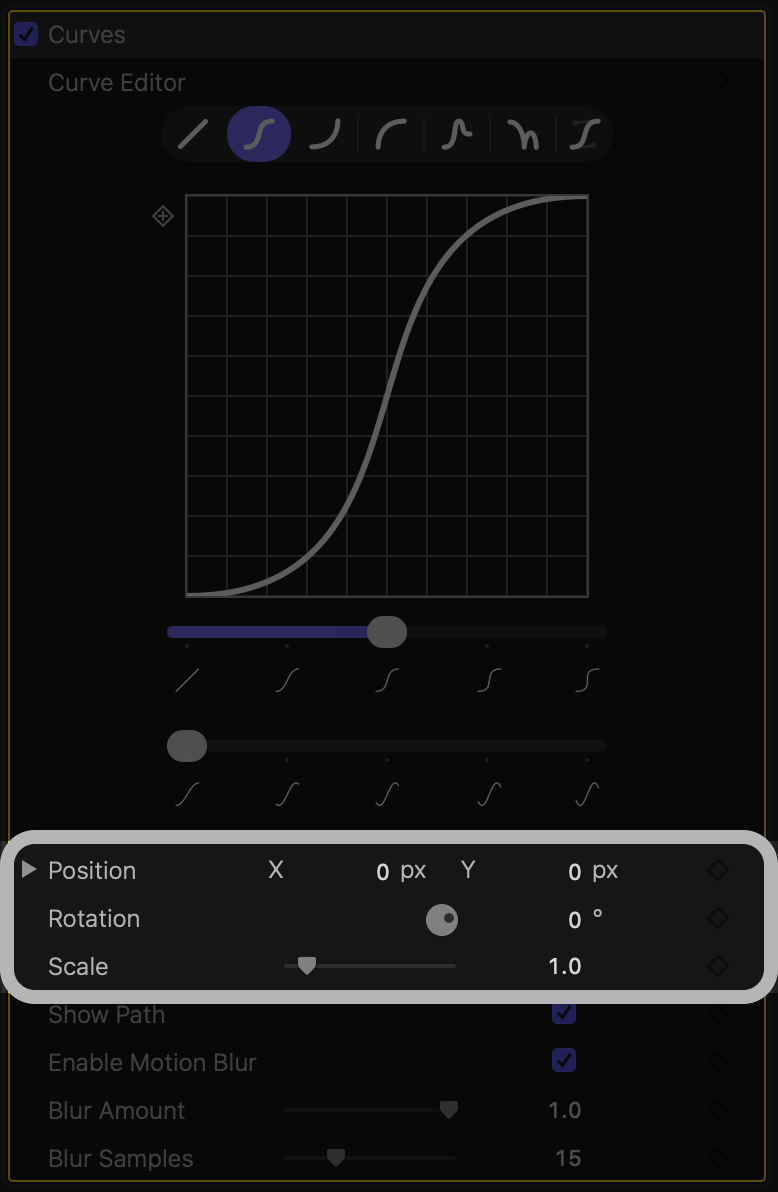
Position, rotation, scale, and the anchor point can be adjusted in the
inspector under the Curves effect parameters.
✅ Adjust parameters inside the Curves effect.
Make sure when you're adjusting settings in the inspector that you are always
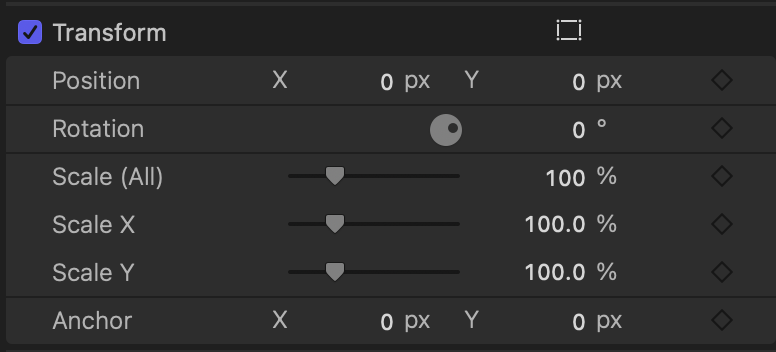
using the settings from Curves, and **not** from the object's Transform:
❌ Do not modify the built-in "Transform" parameters.
The built-in Final Cut transform settings should be left at the defaults (X =
0, Y = 0, rotation = 0°, scale = 100%). If you modify position, rotation, or
scale from both Curves and the Final Cut built-in Transform, things may get cut
off or look weird.
### Translation
You can adjust the position numerically using the inspector. Of course, you can
also just click and drag the clip using the on-screen controls.
### Rotation
Twist a rotation dial to spin the clip. You can rotate along the X, Y, or Z
axes.
!!!
2D rotation is controlled by the **Z** axis.
!!!
### Scaling
Use the scale slider to adjust the clip's size. Set the scale mode to
"Flexible" to adjust X and Y scaling independently.
### Anchor Point
The anchor point is where scale and rotation are applied from. You can think of
it as the "center" of the object. If you hold the option key (⌥) and drag the
control point, the clip will remain fixed in place, and the anchor point will
move relative to it. Now, when you rotate or scale the object, the rotation/
scaling will start from this new anchor.
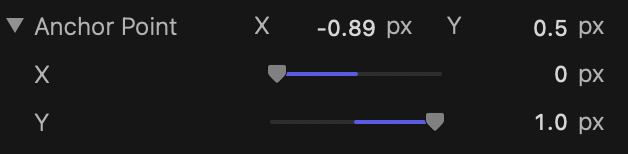
You can also adjust the anchor point in the inspector using the sliders:
A slider value of 0 means "left" or "bottom", and 1 means "right" or "top".
### Projection Mode
Use the `Projection Mode` setting to adjust how your 3D rotations are presented
in the world. Object projection keeps your object oriented the same way no
matter where it is in the scene. World projection projects your object into the
3D scene, so as you move it around, its orientation relative to the camera will
change. This setting has no effect if your X and Y rotations are set to 0.
 ). A yellow box will appear
around it.
). A yellow box will appear
around it.
 A control (
 ) will appear
in the viewer over the center of your clip. Click and drag it to move your
object around:
Curves tries its best to help you keep everything aligned in your scene by
snapping your object to the center or lower/ upper thirds. When you add
animations, Curves will snap to align with other keyframes as well. This helps
keep your animations centered, fluid, and consistent.
However, it may be desirable to disable snapping in certain scenarios. Start
dragging the object then hold down one of the following keys to configure the
dragging behavior:
{.compact}
Key |Effect
--- |---
*None* | Snap to the center, lower/upper thirds, and other keyframes.
Option (⌥) | Move the anchor point instead of the object itself.
Shift (⇧) | Only allow horizontal or vertical movement, but not both.
Control (^)| Snapping disabled.
# Using the Inspector
Position, rotation, scale, and the anchor point can be adjusted in the
inspector under the Curves effect parameters.
) will appear
in the viewer over the center of your clip. Click and drag it to move your
object around:
Curves tries its best to help you keep everything aligned in your scene by
snapping your object to the center or lower/ upper thirds. When you add
animations, Curves will snap to align with other keyframes as well. This helps
keep your animations centered, fluid, and consistent.
However, it may be desirable to disable snapping in certain scenarios. Start
dragging the object then hold down one of the following keys to configure the
dragging behavior:
{.compact}
Key |Effect
--- |---
*None* | Snap to the center, lower/upper thirds, and other keyframes.
Option (⌥) | Move the anchor point instead of the object itself.
Shift (⇧) | Only allow horizontal or vertical movement, but not both.
Control (^)| Snapping disabled.
# Using the Inspector
Position, rotation, scale, and the anchor point can be adjusted in the
inspector under the Curves effect parameters.
 A slider value of 0 means "left" or "bottom", and 1 means "right" or "top".
### Projection Mode
Use the `Projection Mode` setting to adjust how your 3D rotations are presented
in the world. Object projection keeps your object oriented the same way no
matter where it is in the scene. World projection projects your object into the
3D scene, so as you move it around, its orientation relative to the camera will
change. This setting has no effect if your X and Y rotations are set to 0.
A slider value of 0 means "left" or "bottom", and 1 means "right" or "top".
### Projection Mode
Use the `Projection Mode` setting to adjust how your 3D rotations are presented
in the world. Object projection keeps your object oriented the same way no
matter where it is in the scene. World projection projects your object into the
3D scene, so as you move it around, its orientation relative to the camera will
change. This setting has no effect if your X and Y rotations are set to 0.